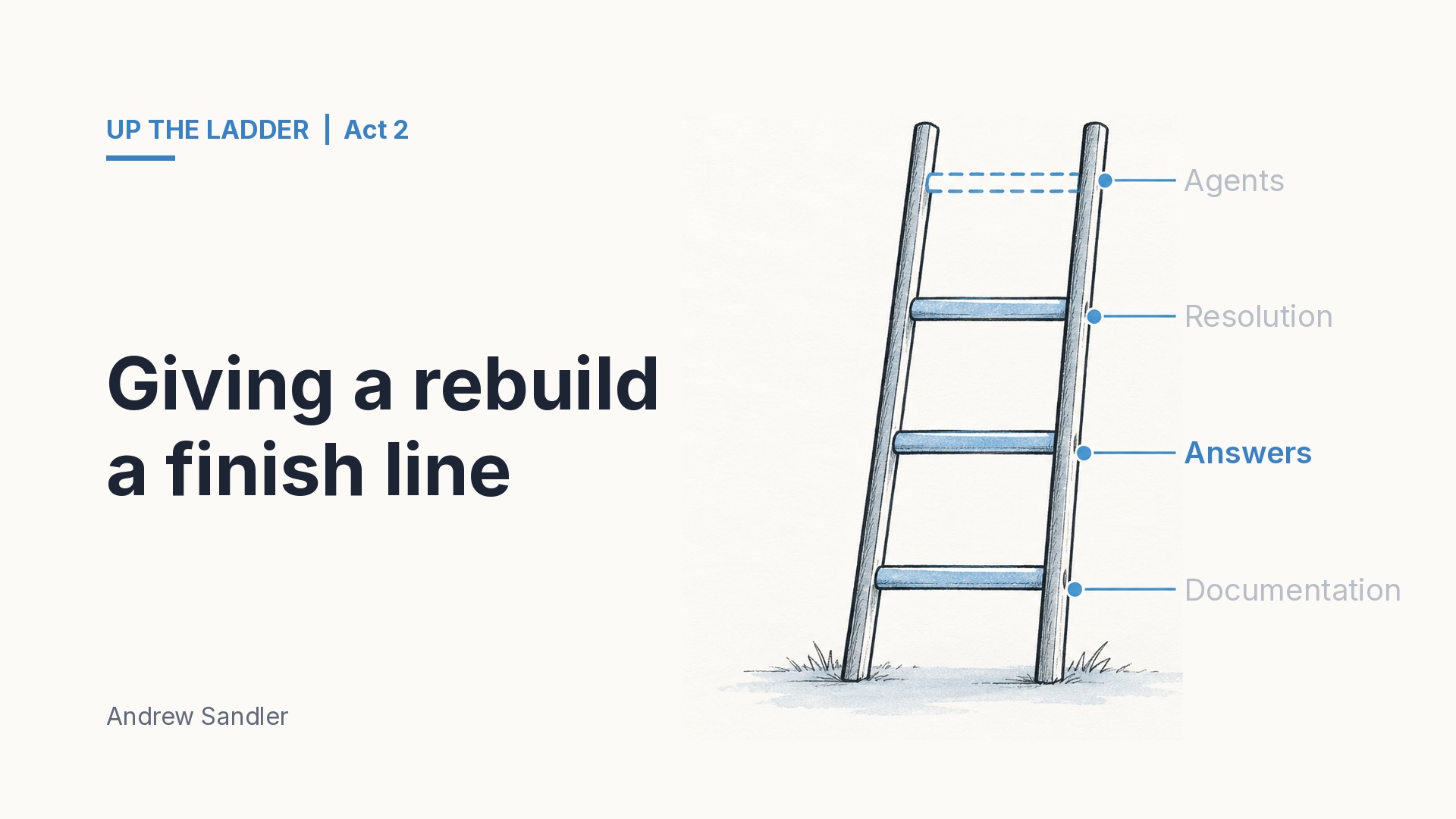
Giving a rebuild a finish line
Articles 5 through 7 covered the decision to rewrite Adobe Help around answers, what the rewrite meant on the page, and how we put a value on the result. This one closes Act 2 with how we finished it.
The rewrite started as a series of experiments, each lasting a quarter. In Phase I, we rewrote content by hand and measured the results against engagement and avoided contacts. Phase II expanded the reach and brought in AI-assisted authoring, and Phase III added external vendors to help scale production.
Every phase taught us something and made the process better. But at that pace, covering the full product suite was still many quarters away. We had a process that kept improving and no real finish line.
Adobe MAX in 2025 gave us one. I set a deadline around the conference, worked with our partners to agree on which products we’d cover, and made sure someone was accountable for each piece of the work. We landed the release at MAX, with the impact we’d been hoping to see.
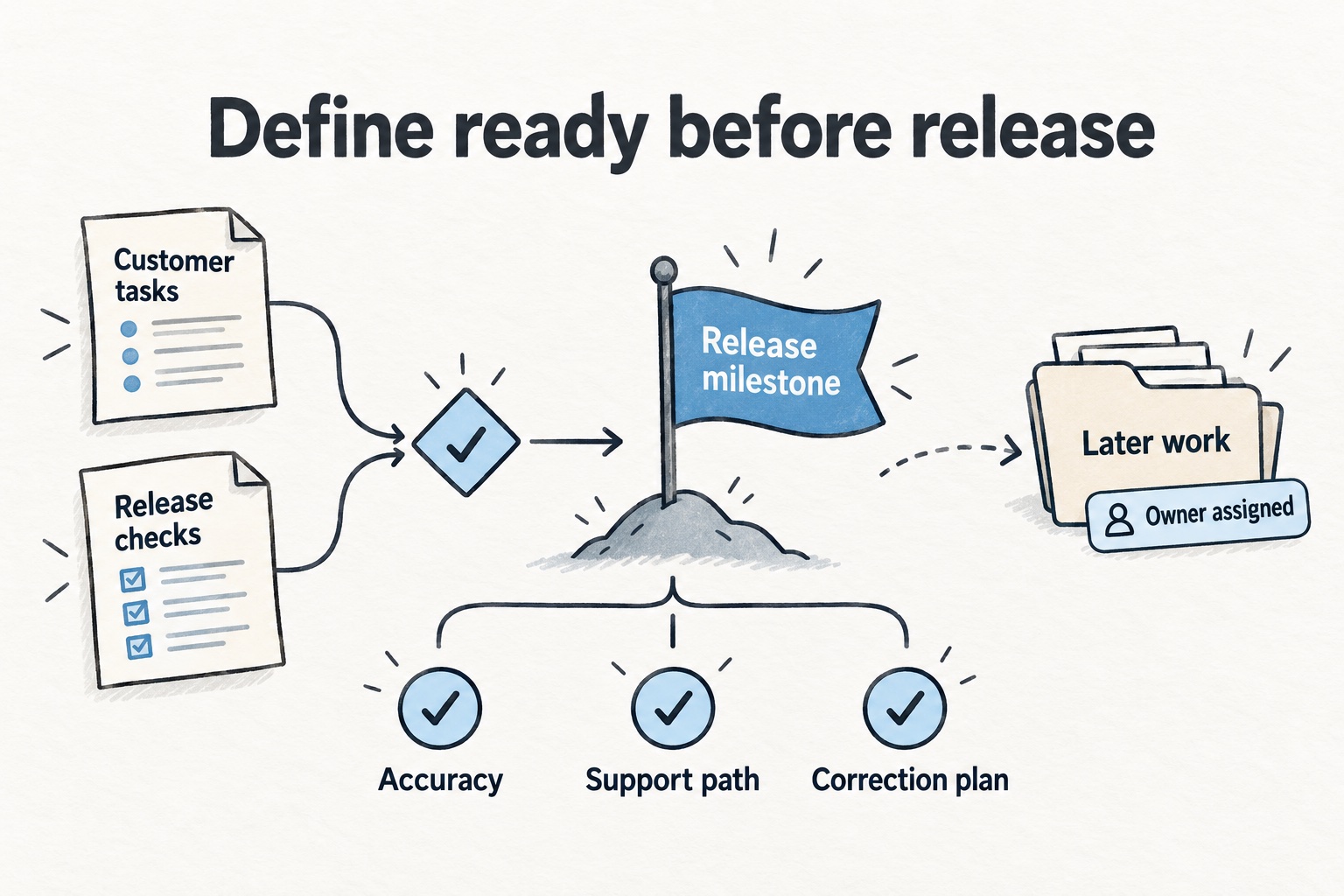
If I ran a program like this again, I’d start the same way. Define what customers should be able to do at the milestone, then make every scope and readiness decision against that definition.
Make scope a decision
Traffic gave us the basis for the scope call. A few hundred articles carried most of our visits, so rewriting those first would change the experience for most customers.
So we committed to rewritten pages for most of our flagship product traffic by MAX. It was a smaller promise than finishing the whole library, and everyone could see what it meant. The work pointed at the pages customers were most likely to land on, and every contributing team had the same target.
We used traffic as the starting point and made room for exceptions. A rarely visited page can still be essential for accessibility, account access, or a serious product problem, and those pages came along on their own merits.
The date forced the trade-offs, but someone still had to make them. My part was negotiating product scope, keeping the commitment in front of people, and making sure whatever moved to a later release had an owner. “Later” only counts as a plan when someone is responsible for it.
Scale production around a shared page
Article 6 covered the content model and authoring workflow behind the rewrite. The approaching deadline put both to the test.
By Phase III, editors, external contributors, and AI-assisted authoring were all producing content. That only worked because everyone was aiming at the same finished page. The content types gave each page a job and a predictable structure, and the three review principles (efficient, effective, and engaging) gave reviewers a shared standard.
The structure paid off most with AI-assisted drafting. A model working from a defined task, with prerequisites up front and a way to check success, has much less room to wander than one asked to write an article about exporting. A fluent draft can still describe the wrong product version or skip a prerequisite, and it sounds just as confident when it does.
So review had to grow with drafting. The shared structure made production repeatable, AI helped us scale it, and people stayed responsible for accuracy and the final call to publish.
Protect the release
A count of finished drafts tells you how production is going. Readiness is a separate question: is the content accurate, does it support the task the page is for, and does the experience hold up when someone needs it?
Some reasons to move a date are good ones. A quality problem that affects customers deserves a different response than an improvement that can wait.
Looking back, I’d draw those lines as early as possible, before every open issue turns into a debate about the deadline. That means deciding what blocks the release, what can move to a later version, who makes the call, and which measures to watch after launch. The scorecard from article 5 and the outcome tests from article 7 apply here too, because shipping on time only matters if the release helped customers.
Make contributions visible
Bringing that many teams together around MAX meant depending on people who had other commitments and often didn’t report to whoever was leading the program.
Clear ownership helps those teams coordinate, and credit matters too. I try to thank people specifically, in places where it can be seen, like leadership updates, launch communications, and the rooms where the work gets reviewed. If you’re going to name someone publicly, ask first.
What it cost
A hard date cost us scope. We chose the pages customers used most over finishing the entire library, so some content moved to later releases and some improvements missed the first version.
It also meant giving up the comfort of one more experimental phase. In return, we got a program that made its decisions.
What Act 2 left us with
Act 2 started with a decision to stop optimizing a structure that had reached its limits. It ended with a content model built around tasks, predictable structures, and ways to check success, and a release that put all of it in front of customers.
That structure made pages better for readers. It also made them easier for a mixed team of people and models to produce, and easier for machines to read. Act 3 picks up there, as more customers find help content somewhere other than the help site, in AI answers, inside the product, and eventually through agents acting on their behalf.
What would “ready” mean for your next milestone, and which scope decisions are you putting off until a date forces them?
I worked at Adobe, where I led the Help experience team from 2020 to 2026. Views are my own.