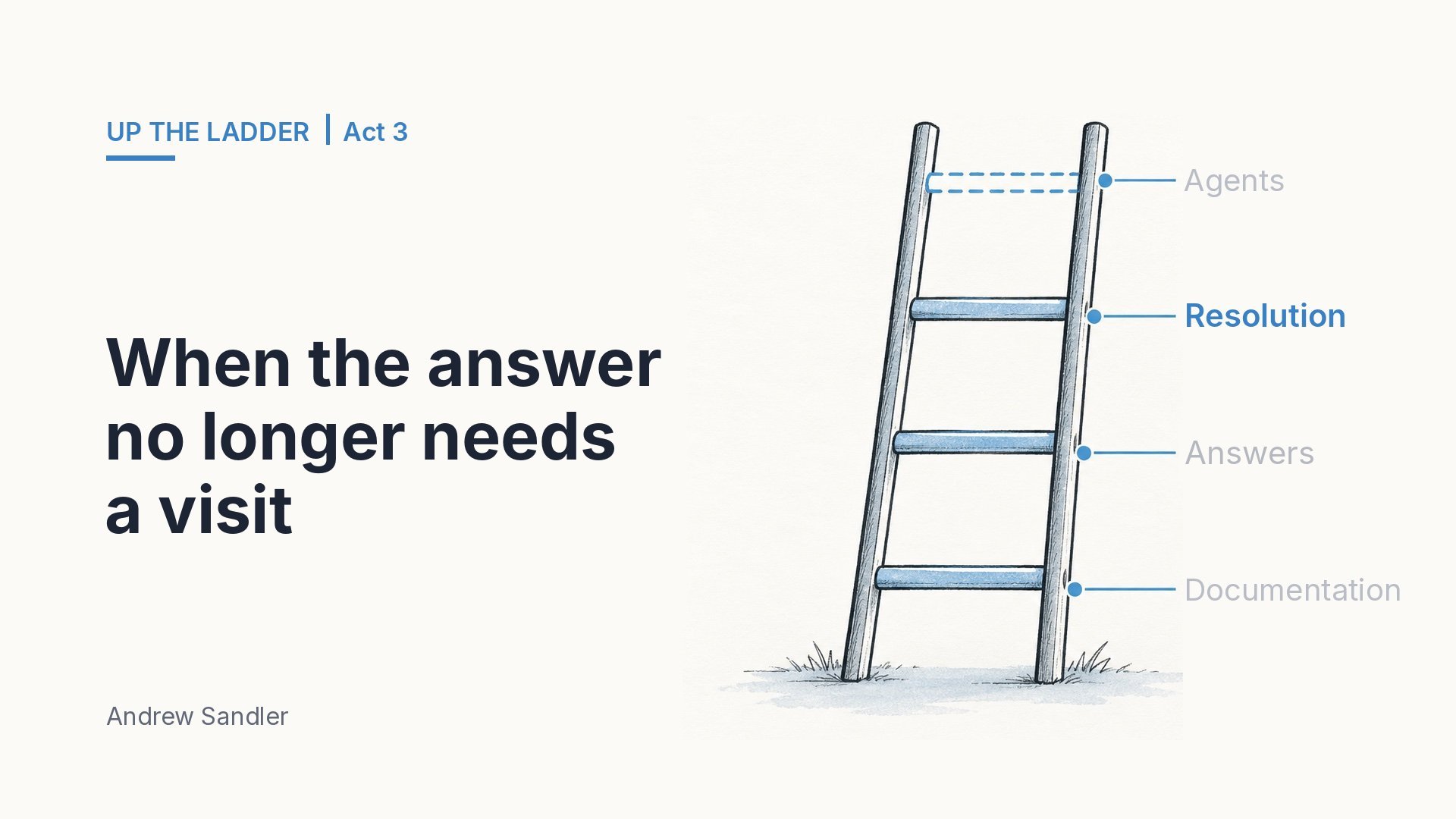
When the answer no longer needs a visit
Act 2 ended with a release of rewritten pages built around tasks, with predictable structures and clear ways to check success. We had spent years making Adobe Help a better destination. The pages were clearer, the answers were easier to find, and we could tell more reliably whether someone succeeded.
All of that work rested on an assumption we hadn’t questioned. When customers had a problem, they would come to the help site to solve it. By 2025 that assumption was weakening, and it raised a harder question than any we faced in Act 2. What happens to a destination you have spent years improving when customers get the answer without arriving?
I came to believe that help had to be judged by whether it resolved the customer’s problem, wherever the answer appeared. Getting there meant changing measures we had relied on for years, starting with how we knew our answers were being found. Act 3 is about what that meant for the scorecard, for the content, and eventually for what help is.
The answer moved
For most of the last decade, search was the front door to help. Someone hit an error, typed it into a search box, and landed on an article. Help teams built their measurement around that path: visits, rankings, time on page, and the support contacts those visits avoided.
Generated answers shortcut that path. Pew Research found that Google users who saw an AI summary clicked a traditional result in 8% of visits, compared with 15% when no summary appeared, and clicked a link inside the summary in about 1% of visits. Pew’s data is observational, and the pattern is still hard to miss. SparkToro’s analysis of early 2026 data puts the share of U.S. Google searches ending without a click at 68%.
A search that ends without a click says nothing about whether the customer’s problem was solved. It does show that clicks have stopped being a reliable measure of reach. Many support questions are long, specific, and phrased as questions, which is the kind of search most likely to produce a generated answer. That answer may come from your content, and the customer may never see the page behind it.
Change the scorecard first
The first change was to stop treating search traffic as the measure of success. For years, rankings and organic visits had been how we showed that help was being found. We replaced them with placement on the Google results page, and followed Google’s guidance in counting a citation in an AI Overview at the Overview’s own position, usually position 1. That let us see when our content reached customers without a click. However, it couldn’t tell us whether their problem was solved.
That change pointed the work in a new direction. We tested schema.org structured data (JSON-LD) to describe our articles more precisely to search engines and AI crawlers, then planned how to apply it across the library. We also piloted Adobe’s own AI visibility tools, LLM Optimizer and Semrush (now combined as Adobe Brand Visibility), to see where our content appeared in generated answers. Articles 10 and 11 cover that work.
Treat help as a resolution engine
The gap between reaching customers and resolving their problems changed how I thought about what we were building. Help exists to resolve problems. The site, the articles, and the search box were the channels we used to deliver that resolution.
Seen that way, the job changes from running a destination to running a resolution engine, a body of knowledge and eventually capability that resolves customer problems wherever the customer happens to be. Some of those answers will still appear on the help site. More will appear in AI assistants, in search results, inside the product, and later through agents acting on the customer’s behalf.
The question that matters most is simple: Did we resolve your issue?
Measure reach, resolution, and confidence
Resolution is harder to measure than a visit count, and article 7 already showed how hard it is to connect a help article to what happens afterward. I’d organize the measurement around three questions.
Reach asks whether your knowledge appears where customers ask. Results-page placement, citations in generated answers, and coverage across AI assistants all belong here. Article 11 covers how to measure it.
Resolution asks whether customers finished what they came to do. Did they complete the task in the product, come back with the same problem, or contact support anyway?
Confidence asks how much evidence connects help to that outcome. Some sequences can be observed directly, such as a task completed after a reader follows a link into the product. Others take inference, and some stay invisible, like a customer who succeeds after reading a generated answer you never see. Being explicit about which is which keeps the scorecard credible. The aim is enough evidence to know whether your knowledge is helping people succeed, along with an honest statement of how sure you are.
What it cost
The scorecard change cost us a number everyone understood. Search rankings and organic traffic were easy to report, easy to compare from one quarter to the next, and familiar to every leader who reviewed our work. We stepped away from them before resolution data could fully replace them.
That left a stretch where the old measure said less and the new one was still being built. Getting through it took new measurement, agreement on what counted as placement, and patience while we established a reliable baseline. It also meant explaining to leaders how traffic could matter less while help mattered more.
Make the case before the numbers fall
Many support teams built their business case around a channel, usually search. The value worth defending sits underneath it: customers with problems, and whether those problems got solved. I’d restate help’s value in those terms while the old numbers still look healthy, so the case holds when they don’t.
The scorecard was the first sign of a larger change. When customers get answers wherever they ask, help stops being a place and becomes knowledge that has to travel. The next article covers that work, making content readable by machines so the answer can reach customers wherever they are.
If your main channel disappeared next quarter, how would you show that your help experience still works?
I worked at Adobe, where I led the Help experience team from 2020 to 2026. Views are my own.