Content as data
Article 9 ended with a change to our scorecard. We had started counting answers that reached customers without bringing them to the help site. That raised a question about the system behind those answers. If the website was no longer the destination, was it still the right place to organize our knowledge?
We had spent years making Adobe Help easier for people to navigate and understand. A person reading a web page and an agent retrieving an answer do different work, though. The person can work around navigation, layout, and uneven structure. The agent has to find the right passage, interpret it correctly, and tell an authoritative answer from an outdated or conflicting one.
The pressure came first from our own answer agent. An agent built on the help site’s pages would inherit every inconsistency across them, and help knowledge rarely lived in one place anyway. It sat on the help site, in community answers, in release notes, in the product, and with support teams, often in versions that disagreed. Every assistant and agent outside Adobe that tried to answer a question about our products faced the same problem.
So we made a decision that changed what we were managing. The help site became one way of publishing the source of truth. The source itself became structured knowledge, held in one place and delivered wherever customers ask.
We had solved an earlier version of this
Our first experience with machine readability came through technical SEO in the Act 1 years. We corrected localization signals (hreflang) so each language version reached its market, pruned thin and outdated articles, and cut the sitemap down to the pages worth reading. Each change made it easier for search engines to see what content existed, who it served, and which pages mattered.
The lesson outlasted the techniques. The structure around an answer decides whether a machine can find and use it.
One source, many readers
Converting pages to markdown doesn’t produce reliable knowledge on its own. The work separates into five layers, and each solves a different problem.
- Content model. Gives every answer a consistent structure. Article 6’s content types were this layer.
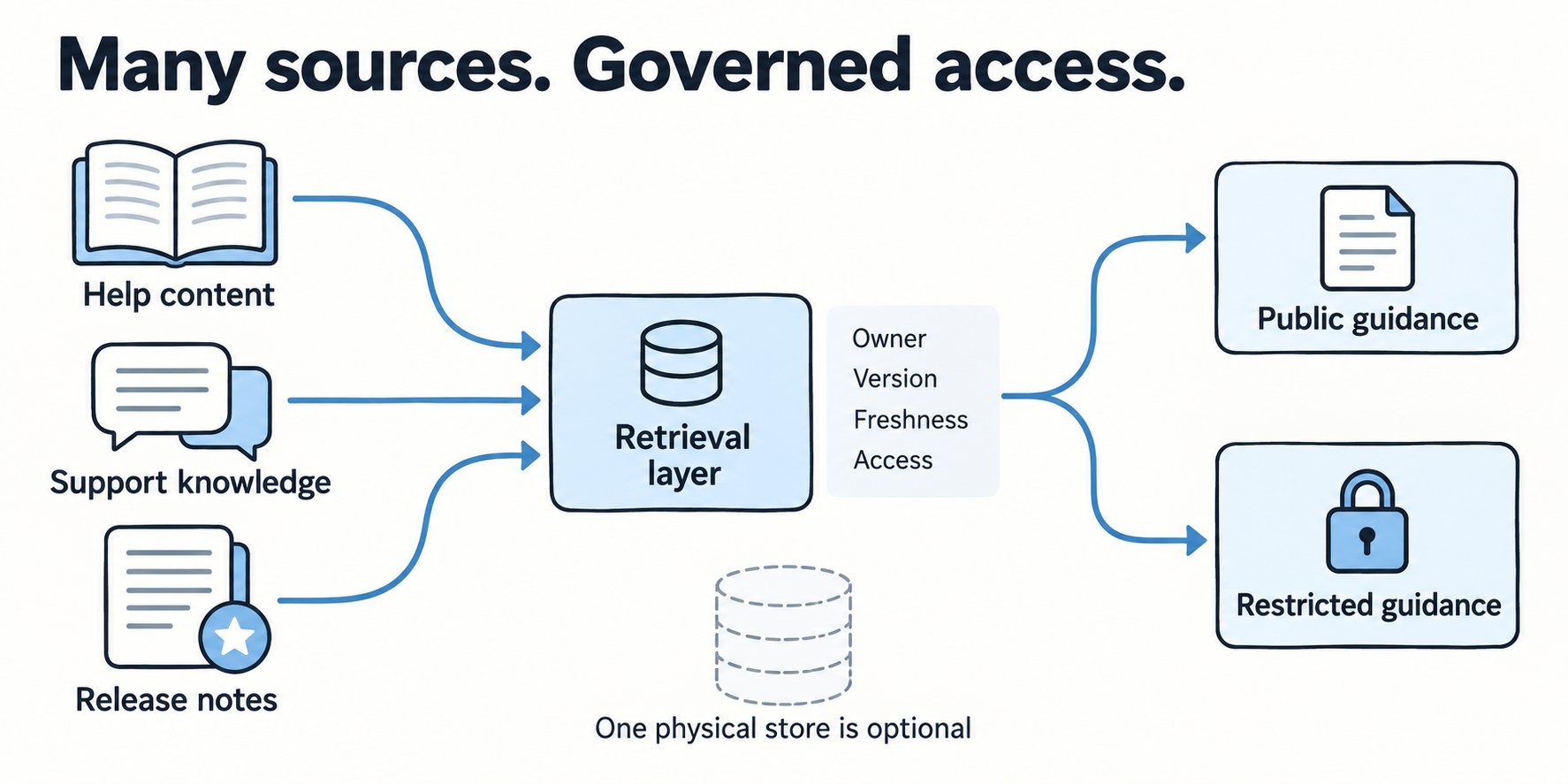
- Knowledge store. Holds one authoritative version of each answer, drawn from the sources that used to compete.
- Publishing formats. Deliver that answer as a web page for people and as markdown and schema.org structured data for machines.
- Retrieval. An API lets our own agent and other systems query the knowledge directly.
- Governance. Keeps answers accurate, current, and consistent across languages.
Article 6 had already laid the first layer by moving authoring to a platform-independent source. That gave us a foundation. Unifying the knowledge still meant resolving ownership, settling competing sources, and deciding how systems would retrieve answers. By the time I left Adobe, the store was live in production, unifying several knowledge sources behind one API.
Governance mattered most once retrieval worked. A well-structured answer that is out of date is still a wrong answer, and an agent repeats it with confidence. Format makes knowledge readable. Ownership and review make it trustworthy.
Google’s guidance is a useful check on the formats. Its 2026 guide to generative AI features says Search needs no markdown or AI-specific files and ignores them, and that no special structured data is required. Optimizing for Google Search and designing knowledge for your own agent are different problems, and the second one justified the work. Conventions such as the llms.txt proposal may help agents discover markdown pages, but they depend on the layers beneath them.
Start small, then build it into the system
Article 9 mentioned our structured data test. We added schema.org JSON-LD to a subset of articles before committing the library, because markup across a large, localized site is expensive to add and maintain, and a wrong guess repeats on every page in every language.
The pilot taught us where markup belongs. Markup built page by page drifts from the page it describes. Markup generated from the content model stays consistent, so we gave each content type one template that describes it in structured data. New articles inherit that markup when they are published, in every language, and a mistake gets fixed once, in the template.
We also chose against writing separate content for AI systems. A second copy of each answer, tuned for machines, would have doubled the maintenance and invited the two versions to drift apart. One source served people and machines alike, so every fix reached every reader at once.
What it cost
Content as data asks writers and engineers to care about readers they will never see. Every structured field is one more thing to maintain, in every language, for as long as the page lives.
It also moves errors upstream. A mistake that once sat on a single page now travels to every surface that draws on the store, which raises the bar for review as reach grows.
Can an agent use your knowledge?
These are the five questions I’d ask before writing any agent code.
- Fetch a popular article as plain text. Is the answer still there once the page around it is gone?
- Does each answer have one authoritative source, or do the help site, community, and support teams each keep their own version?
- Does each content type have a defined structure, and does its markup match what the page shows?
- Can your own systems retrieve the content through an API, or would your agent have to scrape your site?
- Can you see which machines request your content, and can you test whether they retrieve the right answers?
The temptation is to start with the agent: pick a model, connect it to the help site, and see what it can answer. I’d start one layer lower. Find out whether your knowledge has a consistent structure, whether your sources agree, and whether a machine can retrieve the right answer without rebuilding it from a web page.
We spent years making help easier for people to use. The next challenge was making the same knowledge reliable for the systems acting on their behalf. That work begins with the content.
Making knowledge available still leaves open whether anyone credits the source. Article 11 picks up there.
Would you trust an agent to answer customers using the knowledge you publish today?
I worked at Adobe, where I led the Help experience team from 2020 to 2026. Views are my own.