When to stop optimizing
Act 1 of this series covered the documentation era: listening before setting a strategy, rebuilding the structure under a live site, and testing where people got stuck. By 2023, all of that was working. The structure was in place, testing was a habit, and the scorecard gave us a shared way to talk about progress. The obvious next step was more of the same.
We decided instead to rewrite Adobe Help around answers, rebuilding the content and the experience around the tasks people came to do.
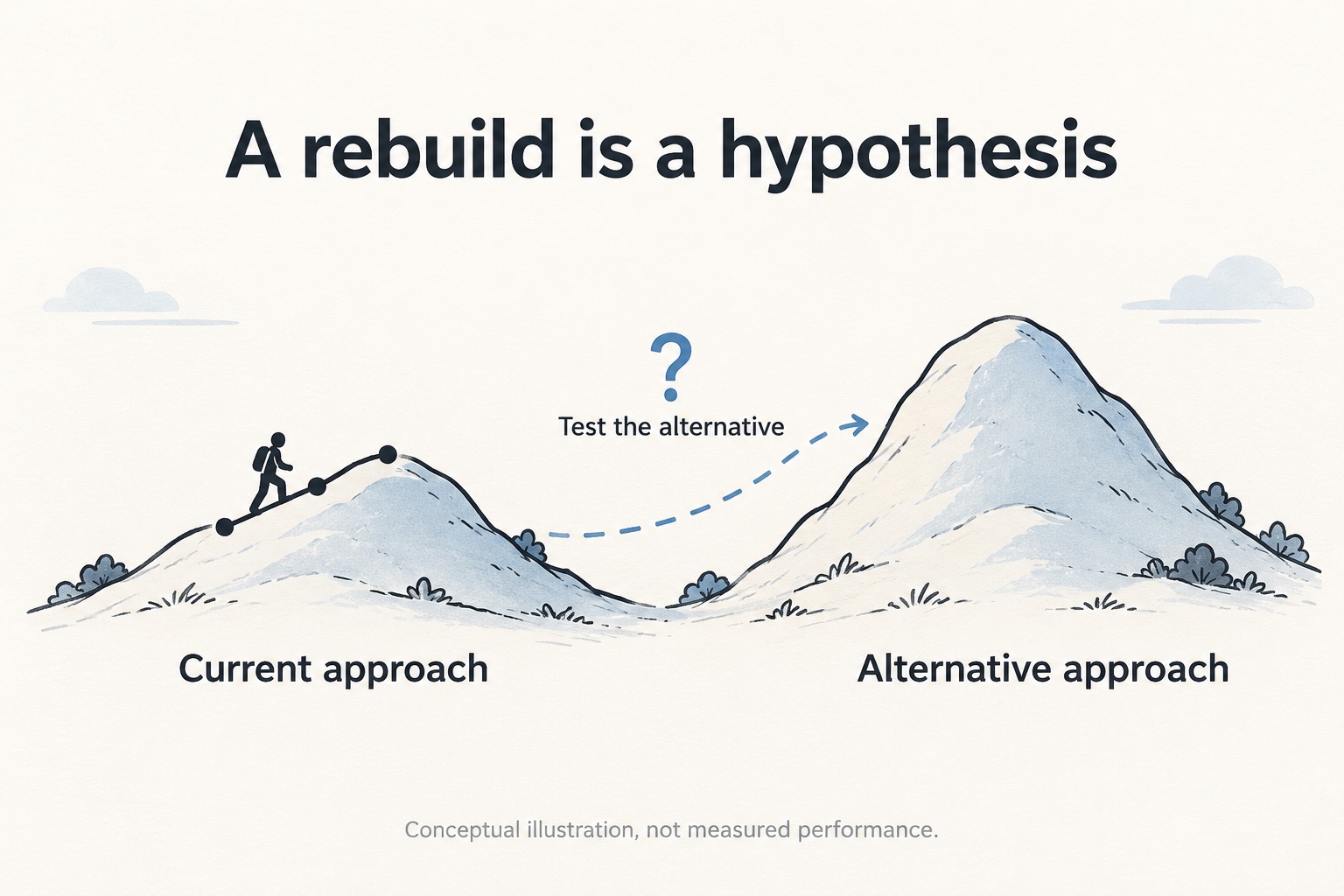
Spotting a failing system is easy. A system that works and has reached the limit of its design is much harder to recognize, and harder still to explain. Tuning gives you a concrete next step every quarter. But sometimes you find you’re at a local maximum, the highest peak in the foothills when you want to be scaling the summit of the whole range.
Looking at what the next fix requires
What settled it for me was asking what the next round of fixes would actually need.
We reached the point where our pages were cleaner, clearer, and easier to navigate. Content was split by product and version, and almost every page had a concrete next step. Most of the library was still organized around features, though, and people were arriving with tasks. Someone who needs to send a file to a client in the right format had to read about export options and work out which settings applied to them.
Better headings and tighter templates made that translation faster, but the reader still had to do the thing. Taking it off their plate meant changing how content was written and organized across the whole library.
So when I consider a rebuild, I ask whether the next fix can fit inside the current structure, or whether the structure itself keeps producing the same problems.
Climbing the nearest hill
If you only take steps that improve your current position, you’ll climb the nearest hill. At the top, every small step looks like a step down, even when a taller hill sits across the valley.
Steady gains on your current approach are real, and they still can’t tell you whether a better approach exists. The testing habit from Act 1 helps here too, as long as some of the tests are aimed at the other hill.
Change the scorecard with the work
The rewrite also changed how we framed the value of help. Contacts avoided stayed on the scorecard. Alongside it, we moved the emphasis toward whether people accomplished what they came to do, whether they went on to succeed with the product, and retained customer value.
Changing the measure mattered as much as changing the plan. Teams build toward whatever is being measured and monitored. If the goal is to help people complete tasks, a scorecard that leads with avoided contacts will keep pulling the work back toward the old hill.
This is where the question from article 4 comes back. Did the answer actually help the person who came looking for it? Activity can mean progress or confusion, so the scorecard has to connect action to outcomes you can observe.
Make the tradeoff explicit
A rebuild takes capacity from work you could otherwise ship. It can surface dependencies a smaller change would have avoided. And it often spills over into process and operations conversations about how the work gets done. While it’s underway, some measures may look flat or even get worse before the new approach has a chance to work.
I’d put all of that in front of leadership as context when you ask for a commitment. Describe the customer problem the current structure makes hard to solve, and show what the alternative changes. Run a controlled test on a well-understood part of it first, so you can understand the impact and implications. And decide what “good enough” looks like on the measurements you care about. For the rest, keep improving the existing experience where that still pays off. A rebuild needs a reason the people funding it can see, and the customer problem supplies it.
What it cost
Choosing to rebuild meant setting aside tuning work that still had room to run. We took on a multi-year commitment across several teams, with the risk that comes with any long program, and asked people to accept an argument about structure before the new approach could prove itself.
What I took from it is that the measure you most need to move is often the one your current design can’t move. When steady effort stops changing it, that tells you something about the architecture.
Four questions before committing
- Which customer problem keeps returning despite changes to individual pages?
- What evidence points to the structure, and what would suggest an isolated implementation problem instead?
- What would the new approach let a customer do more easily?
- What could you test before committing to the full rebuild?
These questions make a decision this size easier to explain and easier for others to challenge. It needs both.
What are you trying to improve that your current approach keeps making difficult?
I worked at Adobe, where I led the Help experience team from 2020 to 2026. Views are my own.