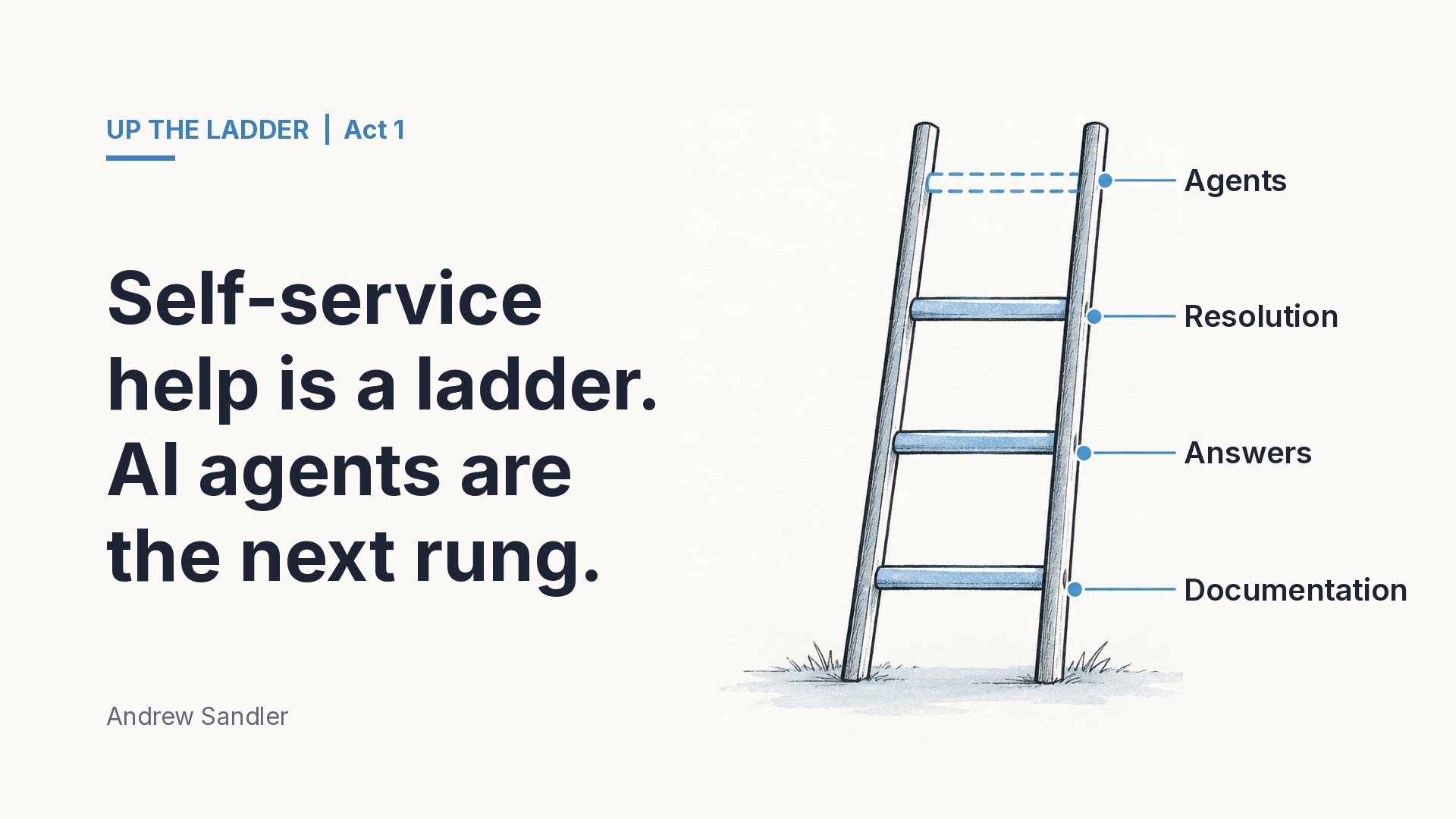
Self-service help is a ladder. AI agents are the next rung.
People land on your help page because something stopped them. A download stalled, an install failed, a deadline is closing in, and your tool isn’t doing what they expected. They desperately want to get back to work, and the help experience either gets them there or it doesn’t.
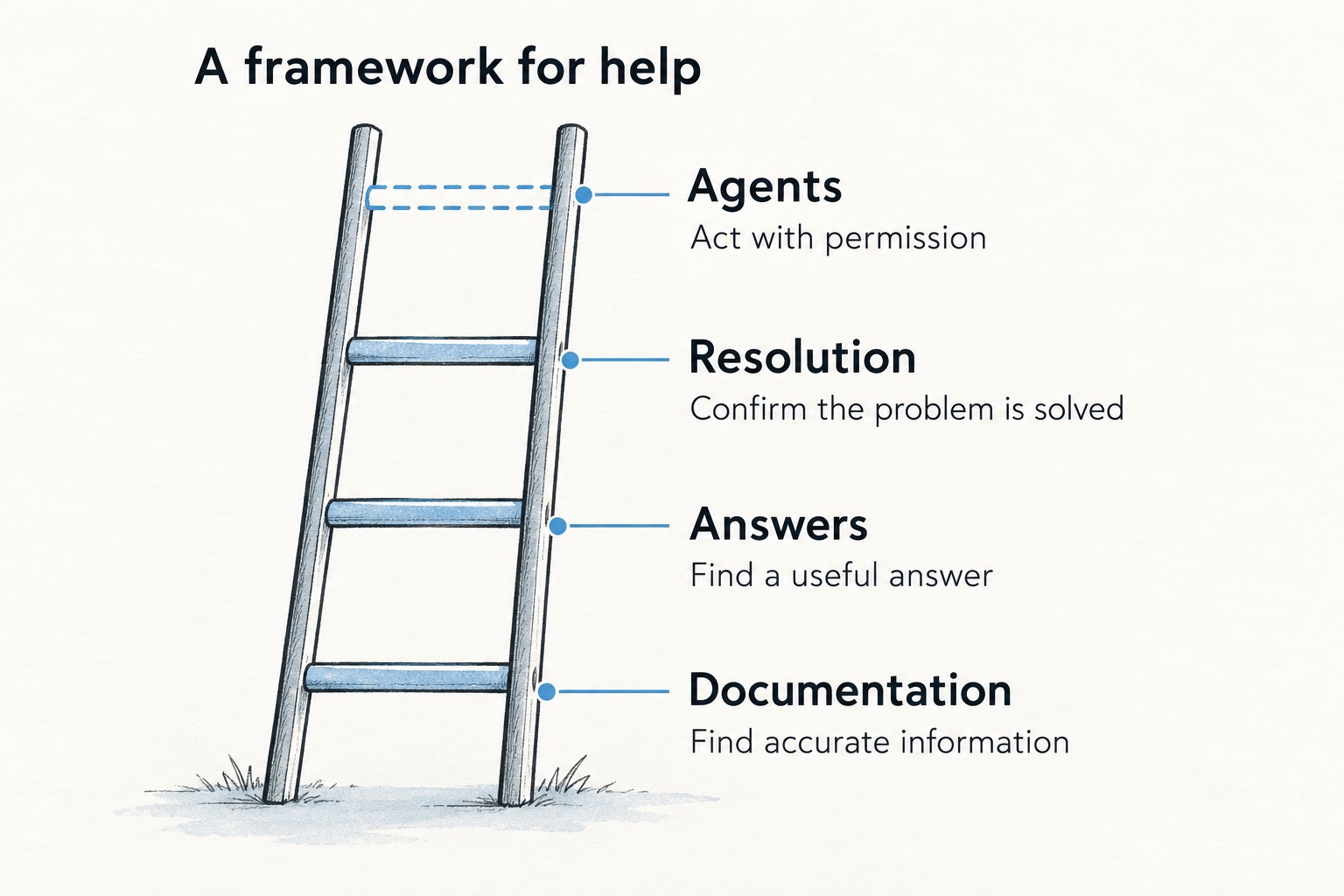
That moment of need has been the focus of my work at Adobe since 2020. As I reflect on where we’ve come from, the job of help has changed twice already. First from online documentation to answers, then from answers to resolution. And now AI tools. Each of these can be considered a rung on a ladder, and each rung changes what a team builds, how it prioritizes, and how it decides whether the work succeeded.
Agents are the fourth rung: AI that can diagnose a problem, understand the customer’s specific situation, and then act on their behalf.
This series looks back at what the first three rungs required and how they set us up for an agentic help future. An agent inherits all of it, including the content, the measurement, and the organization behind them.
Documentation
The first rung is documentation, and the job is to provide accurate information that people can find. In the media world, the metrics are around discovery and consumption. In the support ecosystem, the metrics orient around deflection and the support contacts that the content helps avoid.
Deflection brings help sites into the budget conversation because it maps to spending that finance already tracks. Each support conversation has a weighted cost, and a good article potentially means fewer people reaching out as a result. The measurement impact here is silence. A customer who reads a page and fixes their issue looks identical to the one who read the same page and gave up; neither of them contacted support. If you focus on deflection, you never know which situation your customer ended in.
Answers
The second rung starts from a customer’s question. Can they find an answer that they understand, and can they act on it?
Writing for those questions looks different. Long, comprehensive articles turn into short, guided steps. Content built around product features gets rebuilt around the tasks people use those features for. Every page needs to make sense to someone stuck halfway through a problem who lands on it from a search.
In this world, engagement is the measurement that’s used. It shows whether people find and use those answers, but it takes some work to turn the data into insights. A long visit might mean the page is working, or that the reader got lost. Feedback and evidence of a completed task can settle which is which.
Resolution
The third rung asks whether the customer’s problem got fixed. It moves us from thinking of help as a thing you read to a set of connected capabilities you integrate and measure.
Self-resolution means that the customer solves the issue without a support person. Proving it takes more than counting page views, scroll length, or avoided contacts. You need a link between help and an outcome, and each problem type has its own success signals. A billing issue might result in an updated credit card, a download issue might be measured by a successful app launch, and a password issue could be resolved when you see a successful login.
I like this measure because it uncovers all the gaps. It pulls the team beyond the article to really think about what a successful customer outcome would be. Sometimes the issue is in the product, in the route to the page, or in the handoff to support.
AI Agents
Our future fourth rung are agents that can understand, diagnose, and act, which gives help a new job. They provide specific, personalized assistance to the customer and do the work for them when they can.
None of this happens without the previous rungs. An agent needs accurate content to reason from, permission to act, and a way to confirm the action worked. Someone has to own the quality of the documents, someone has to own each action an agent can perform, and someone has to own the path to talk to a human when the agent gets stuck.
Skipping those steps leads to agents that create a confusing journey much faster, without making it better. Measurement here is a mix of the explicit user feedback from the documentation phase and the implicit measurements that come from answers and resolution. The superpower that agents add is the ability to see what every customer is looking for, in the form of their questions. This leads to better AI training opportunities, uncovers the need for more or different content, and can point to actions or integrations that you might not have considered.
What changes on each rung
Measurement often drives behavior, so your definitions of success go first. Under deflection, coverage wins. Under engagement, discoverability and structure win, and unhelpful content gets rewritten or cut. Under resolution, the whole journey is considered: the question, the page, the product, the support path, and the handoffs between them.
In each article I’m going to share what we chose, what it cost, and what I’d keep if I were doing it again.
The series
Act 1 covers our documentation era, including listening before writing a strategy for help, rebuilding our publishing platform while keeping a live site going, and choosing where and what to test to validate the approach.
Act 2 covers the move to answers, including knowing when to stop tuning the old approach, rewriting around customer tasks and questions, explaining to the business what the work is worth, and giving a long rebuild an aspirational finish line to keep the organization moving forward.
Act 3 covers resolution, including how help evolves as the search world changes, content as data, monitoring AI citations and SEO/GEO, evaluating AI answer quality, measuring self-resolution, and moving from explaining to doing.
Coda. Closing it all out
Find your rung
Use these questions to place your team’s work and to look for the evidence behind each answer.
- Documentation: Do you know what content you have, who owns it, and whether it’s accurate? How do you assess the contacts it helps avoid?
- Answers: Is your content organized around the tasks people arrive with? How do you tell a useful visit from a confused one?
- Resolution: Can you show whether customers solved their problem, broken down by problem type?
- Agents: For each action, do you know who owns it, what permission it needs, and how you’ll confirm success or reach a person?
Most teams sit on different rungs for different problems. Knowing where you are for each can help you focus on what to work on next.
Which problem can your help experience reliably solve today, and how do you know?
I worked at Adobe, where I led the Help experience team from 2020 to 2026. Views are my own.